
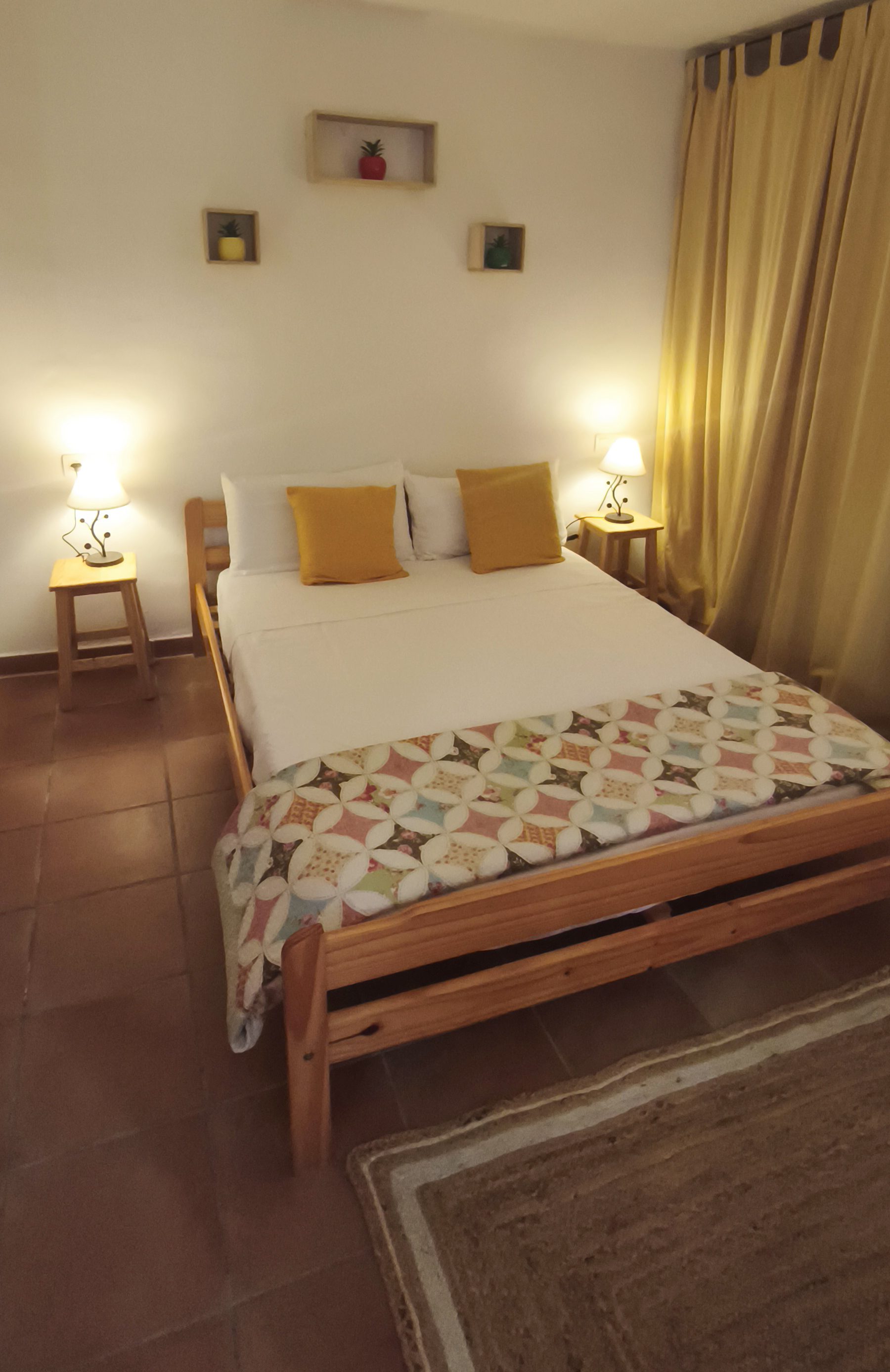
 📷 4 photos
MOCLÍN, GRANADA
Tesoro de Moclín · Apartamento
Self-contained apartment for 2 people.
What we offer
Free WiFi throughout the house
Pets welcome
Close to walking trails
Inner courtyard
Outdoors
- Sofas
- Outdoor dining area
- Garden
- Terrace
- Inner courtyard
Bathroom
- Toilet paper
- Towels
- Shower
- Washbasin
- Hairdryer
Kitchen
- Stovetop espresso maker
- Microwave
- Oven
- Toaster
- Kettle
- Kitchen utensils
- Fridge
- Hob
Bedroom
- Bed linen
- Hangers
- Wardrobes
- Fan or air conditioning
Languages spoken
- Spanish
- English
Internet
- Free WiFi throughout the house
General
- Cot available on request
- Washer/dryer
- Iron
- Close to walking trails
Living area
- TV
Pets
- Pets welcome
Places of interest nearby
- Granada Airport 32 km · 33 min by car
- Granada city centre 38 km · 40 min by car
- Alhambra 40 km · 50 min by car
- Ruta del Gollizno 7.4 km · 12 min by car
- Alcalá la Real 26 km · 25 min by car
About this place
A charming house right in the centre of Moclín, one of the most history-rich villages in Granada. Life moves slowly here: quiet streets, neighbours who say hello and, crowning it all, the silhouette of the Nasrid castle that once marked the frontier of the old kingdom of Granada.
The house keeps the essence and character of the area's village homes, combined with a carefully considered, contemporary look. Every space has been thought out to convey calm, comfort and authenticity, respecting the traditional soul of the house but with all the modern comforts for a cosy stay.
And since no one is left out at home, pets are welcome here too: this is pet-friendly accommodation, so that no member of the family misses out on the getaway.
From the front door, everything is within walking distance: climbing up to the castle, walking the Gollizno route between gorges and walkways, or simply sitting down to take in the mountain and olive-grove landscape that surrounds the village.
Ideal for families and groups looking for nature, history and the authentic experience of living for a few days in an Andalusian village, in a setting where the rural and the contemporary live side by side in balance.
History
In Moorish times, the tower crowning the castle of Moclín, also known as the Keep, was the closest one to the Alhambra, and so countless messages were sent from there to the Nasrid fortress, warning that the Catholic troops were drawing ever nearer. Its warnings ceased when the village fell to the enemy's advance in 1486, six years before Granada, by then the last stronghold, did the same.
The castle of Moclín is therefore part of the history of old al-Andalus and of the Spain that emerged under the Catholic Monarchs. It is a monument that has stood there since the 13th century and which was quite deservedly declared a Historic-Artistic Monument in 1931. It is also listed as an Asset of Cultural Interest in the category of monument.
For many people, however, what identifies Moclín most of all is its Cristo del Paño and the pilgrimage held in its honour every 5 October. The painting, which depicts Jesus Christ carrying a cross, hangs in the chancel of the Church of La Encarnación, also known as the Sanctuary of the Cristo del Paño, which dates from the early 16th century and stands just below the castle.
It should be explained that the name paño (cloth) does not come from him being shown holding a piece of fabric, but from the miracle attributed to him of having healed a sacristan who most likely had cataracts and used to cover his eyes with a cloth or veil.
The origins of the painting – which measures 2.64 metres high by 2.21 wide – are also a matter of debate. Tradition has it that it was carried by Catholic soldiers during the Reconquest and later given to the village, yet some historians maintain that, although it bears no date, it must be later, possibly painted by a follower of Titian, since they see his influence very clearly in it.
And the controversy does not end there: during the Civil War, the canvas was rolled up and hidden in the church. Some say that, to avoid any risk, the Archbishopric of Granada ordered it to be moved to the cathedral. Officially it stayed there until the war was over, after which the original is said to have returned to Moclín, with a copy made especially for the cathedral in the capital. Or was it the other way round? Is the Cristo del Paño in Moclín the original? It seems that it is, not least because the canvas in Moclín is somewhat the worse for wear, surely as a result of all that coming and going.
No one knows for certain, but what is beyond doubt is the devotion it inspires.
What to see
The castle is a hundred metres from the front door. It is a 13th-century Nasrid fortress that once marked the frontier of the Kingdom of Granada, and signals were sent to the Alhambra from its keep. It can be visited at weekends; on weekdays, by appointment with the Town Hall.
Just below it stands the Sanctuary of the Cristo del Paño, in the Church of La Encarnación. The painting dates from the early 16th century, and the «paño» has nothing to do with cloth: «paño» was the old word for cataracts, and the Christ is credited with restoring the sight of a sacristan who suffered from them. Every 5 October its pilgrimage is held, declared a Festival of Tourist Interest in Andalusia, and it draws thousands of people.
That pilgrimage also has its place in literature: Federico García Lorca drew on it for the ending of Yerma. In the family home at Valderrubio they kept a lithograph of this very Christ. Half an hour away are the poet's two house museums: the one in Fuente Vaqueros, where he was born, and the one in Valderrubio, where he spent his childhood.
Twenty-five minutes away lies Alcalá la Real with its Fortaleza de la Mota, another of the great strongholds of the frontier.
Granada and the Alhambra are three quarters of an hour away, plenty of time for a day trip. It is wise to book Alhambra tickets well in advance: they sell out.
Walks and routes
The Gollizno trail starts twelve minutes away by car and it's the walk people come here to do. It's a circular route of about eight kilometres, three to four hours, with no real difficulty, along walkways suspended above the river Velillos, between ravines, bridges and viewpoints. Along the way you pass rock shelters with prehistoric cave paintings.
The Mozarabic Way of St James also runs through Moclín, the one climbing from Granada towards Córdoba. You can walk a single stage and come back here to sleep.
Nearby is Tózar, well known among climbers for its crags. And for cycling, the tracks through the olive groves linking the villages of the municipality are proper gravel terrain, with real climbs and no traffic.
Further afield, for a full day out: Sierra Nevada and the Costa Tropical are an hour and twenty minutes away by car.